Here is the report on the May 2018 meeting of the Cape Town Amateur Radio Centre.
The meeting was held, as is usually the case, on the fourth Saturday of the month at 14h00 B. This was
Saturday 26 May 2018 and the meeting at our Rondebosch clubhouse was very well attended. Word had spread about the speaker and topic! Our chairman, Rob ZS1SA called the meeting to order promptly and gave us some feedback on the recent CTARC committee meeting held the previous Monday. Various matters come to hand:
- The Morningstar remote station is up and running and in regular use now, and Rob reminded us of the annual access fee payable by users, which is needed to cover the rental on the property. More on the Morningstar remote station here;
- Then, there are still some CTARC name badges which have been ordered, paid for and made, but as yet remain uncollected;
- The Committee (specifically Peter ZS1PGC) has set up a PA system in the clubhouse to assist people sitting in the back rows of the meetings to hear the speakers;
- We have appointed an honorary auditor (in the person of Danny ZS1BL) to keep an objective eye on financial matters now that our exisiting auditor (Barry ZS1FJ) has joined the committee, thereby avoiding a conflict of interests;
- We are preparing for the CTARC's AGM which takes place at the July meeting;
- As our "Lighthouse Weekend" yagi beam antenna (the Force 12 C3) is now mounted atop the club's main mast (since the July storms of 2017), we need to make a plan for a proper HF beam antenna for the Lighthouse Weekend event at Green Point lighthouse, which takes place this forthcoming August;
- The forthcoming meetings for June, July and August are coming up. Follow the links for details;
- A certain radio amateur in our club is being recommended for an award and Paul ZS1S needs the signatures of a number of club members, who are also SARL members, to qualify this motion to the SARL council;
- Tony ZS1TK put out a request for more volunteers to assist with reading our Sunday morning bulletins.
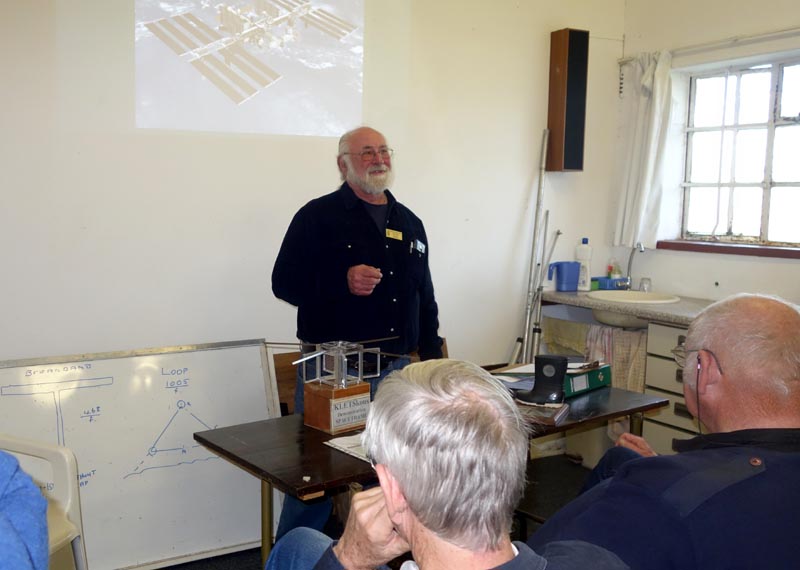
Admin matters concluded, Rob introduced Deon / ZR1DE, the main speaker for the afternoon. Deon needs little introduction, as he is very well known in our community for his enthusiastic interest in Satellites, his active involvement in the Kletskous CubeSat programme at the Cape Peninsula University of Technology and in the worthy AmsatSA organisation.
Deon's well-illustrated presentation was about CubeSats in general, and the FunCube in particular. He launched his talk with a description of how satellites are sent into space by rocket, and how the item, once launched, can remain in orbit with at least a minimum necessary velocity to stay aloft. He showed a map of the main (mostly military) launching sites across the globe, and how South Africa is in a unique position to be the first to spot satellites launched westwards from the US east coast.
We were then introduced to the concepts of Equatorial and Polar orbits, and the "footprint" of satellites as they pass over a stationary observer/radio ham station below, with an available window of about 15 minutes (if the observer below is lucky enough to have a good pass). We saw a slide of the Vandenburg USAF Base from which many satellites are launched from the USA.
What isn't generally known is that CubeSats were borne out of the need to provide ballast on certain satellites for ballistic purposes, until someone had the great idea of using deployable mini-satellites instead of cubes of concrete!
Deon then introduced us to the FunCube satellite, which started off initially as a university project to provide outreach to schools in the UK to generate interest in Space technology. This 100mm square cube has sensors on its corner columns to measure various parameters such as temperature and sunlight, which is then sent by telemetry back Earthside, where an enthusiastic following of people track the satellite and turn its raw data into usable spreadsheet format.
The FunCube has a small computer to run its functions, but no hard drive would survive the launch (or cosmic radiation), so it rather loads up the BIOS and operating system via a miniscule SD card. This means if the system gets corrupted, it can be re-uploaded again.
Similarly, the rigours of launching mean no antenna could survive, so these have to be extended outwards from the CubeSat only once it has been deployed outwards from the spring-loaded launching pod. Up to as many as 12 CubeSats have been deployed from the mother satellite in one go, but typically one, two or three CubeSats are deployed per pod.
The FunCube has antennae for the 2 metres and 70 centimetre ham bands. These are thin (but sufficiently stiff) metal tapes that are unwound to the correct length from the sides of the satellite.
Deon then gave us more insights into the data that the FunCube provides. Initially starting off as analogue measurements taken by the FunCube's sensors, these are then digitised and transmitted from the satellite back to Earth. (An ancilliary project, the FunCube Dongle SDR, has been developed to enable the teams to receive the data directly from the satellite.) This is where the project really comes alive, because the data can be tracked, decoded and analysed to provide functional information about what the satellite is sensing. It gets more involved when trends are analysed over time - daily, weekly and monthly. Deon showed us some fascinating graphs assembled over 16 weeks that show specific trends in temperatures and other parameters measured by the FunCube.
And, of course, there is the transponder, which enables radio hams to contact each other - transcontinentally at times - while the satellite is overhead. You do not need a kilowatt to work FunCube (if you try that level of QRO, the poor widget will switch itself off to prevent its receiver getting burned out!). 20 watts and a dipole antenna (or Yagi) are usually quite sufficient.
Deon concluded by answering questions from the audience, and received a good round of applause for his
very interesting talk.
Thereafter we all had the chance to catch up and chat, and to buy and sell things in the monthly Swop Shop. Thanks so much to Deon for his talk, and to everyone else for attending.
Photos are [
here].
Details of next month's meeting (June 2018) are [
here].